

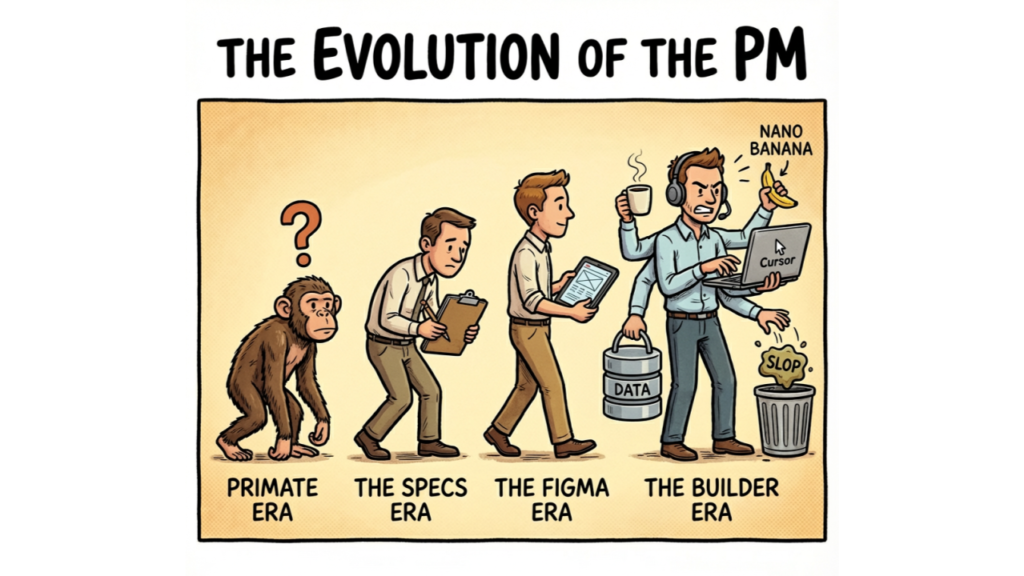
There are a lot of takes on AI and the games industry. To be honest, most of them have some level of truth. Are we seeing a rise in AI slop? Undoubtedly yes. When creation tools become extremely accessible, you are going to get a wide range of quality, and obviously some of it is going to be rubbish. This is true of every tool that’s been created ever.
But that doesn’t mean AI isn’t a force multiplier and enabler for professionals. The differentiator in this new world is taste and curation. In a world where anyone can build anything (in theory), the people who know what is worth building and what good looks like are the ones who are most empowered.
And what does that describe if not a PM, whose entire job is to decide what to build and when? (Yes yes, PM roles are different across different companies. But that, to me, is the fundamental role: to conceptualize and then execute a vision against the backdrop of business objectives.)
AI is not replacing PMs, but PMs who use AI will replace PMs who do not.
Here is how I leverage AI to do my work better and faster. My general approach to AI is that it is going to be right maybe 90 percent of the time (optimistically, and depending on the task). Whether or not to use it depends on how catastrophic the 10 percent is and how hard it is to know whether you are in the 90 percent or the 10 percent.
- Learning: AI can give you very specific, very relevant answers more or less instantaneously. You should fact check, but I have learned so much by just asking questions like “How do x in Unity” or “if I wanted to do x what is the easiest way for a non-technical person to do it” without spending a ton of time sifting through Google results and forums/documentation for the right answer. You can also put in entire screenshots and ask things like “tell me exactly where to click to do x”. Dumb questions are great for AI because AI doesn’t judge you.
- Iteration. AI lets you get to a 90 percent solution infinitely faster. Want to explore different art styles? I can get you 10 visuals with Nano Banana in 10 minutes that we throw a small marketing budget against and test. Our artists can completely reskin a game for art style or theme in a matter of days. You can test a bunch of different marketing creatives and see what sticks. Test and kill ruthlessly.
- Tools. For the first time ever, the people using the tools are empowered to build the tools. I cannot tell you how many times I have been frustrated with a LiveOps tool because of pain points that only become obvious when you are actually trying to use it to… run LiveOps. But at Series, I built my own LiveOps tool. The output is fairly easy to check. When I make changes, does it output data in the expected structure? We leverage UGS remote config with a bunch of JSONs, so I just need to check if the output JSON matches what the code expects and review the diffs for any weirdness. This allowed me to put in a bunch of QOL features like value calculators for offers, the ability to view areas that I am configuring on a grid map, color coding, AI text generation, and so on. All working exactly the way I want them to, as an actual user of the tool.
- Prototyping. Sometimes instead of writing a spec in words, I start with a prototype. This lets me flesh out ideas faster and see if what I have in my head actually works or is fun. It also helps reveal potential edge cases much sooner. None of the code is production-ready and the UI is placeholder garbage, but for a new feature, I will often prototype it in Cursor to visualize the flow and then hand that to an engineer. This is similar to the Figma prototypes I used to build and run user testing on, just 100 times faster and functionally closer to the real thing. The static prototype is dead.
Here is what AI is not good at (yet):
- Writing specs. My specs are very specific. Here is the exact data structure you should use so we can run LiveOps. Here are the parameters. Here is a rough sense of UI that I think would work. AI works better in broad strokes. I use it for ideation and rewriting for clarity when I already have thoughts down. It struggles with starting from scratch (and yes, I have used ChatPRD). And following the 90/10 rule, if I still have to read every word to ensure it has not hallucinated, I might as well write the outline myself.
- Economy balance. Same deal. If I have to check all the numbers anyway, I might as well have modeled it myself from the beginning. A single decimal point hallucination in economy balancing can completely wreck monetization and the core loop so it’s just not worth offloading this at the moment. However, it is very helpful in doing narrowly scoped, complex calculations (e.g., solving the coupon collector problem for gacha, or running Monte Carlo simulations). You can check for ballpark accuracy by making the same request across multiple models (e.g., Gemini, ChatGPT, and Claude). Trying to get the same model to check its own work is pointless, as if its logic was flawed the first time, it would probably double down next time, but you get better results triangulating between different answers. If they are wildly different, you should probably do the math yourself, but if they all come back with the same answer it’s probably right.
We are entering a phase where PMs are not just writing requirements. You can shape products hands-on, testing, automating, building micro-tools, and spinning up real prototypes without waiting in line for engineering time. The job is still the same: decide what is worth building and make it real; AI just empowers you to do that better, faster.